

WHY first impressions aren't always right
Society has been built on the premise that first impressions are everything.
“You never get a second chance to make a good first impression.”
“First impressions make a lasting impression.”
While you should always put your best foot forward, first impressions can be wrong. And this“pressure”around first impressions plays into the performance-based standards that have created an anxious, stressed, depressed and burned-out generation (or two).
Origins of the first impression bias
In my recent interview with Dr. Rick L. Mask, adjunct professor and dean at Southern New Hampshire University, author and globally-renowned speaker and expert on social capitalism, we discussed why judgement upon the first impression is often a mistake in modern society.
In the interview, Dr. Mask says that those first impression instincts date back to the earliest form of humanity, you know, the cavemen days when survival depended on discerning danger. Of course, back then, there were saber toothed tigers, food scarcity, and battles over undefined territory.
Today, those survival instincts kick in as a response to someone who forces you out of your comfort zone because they act or dress in a way that is counter to your own beliefs. This could be anything from the way someone is dressed to the color of their skin or the way they talk or their accent, or political beliefs. In recent time—much thanks to social media, where algorithms reinforce biases on minute-to-minute basis—beliefs have evolved to a polarizing level. Few people can or even want to try to see the other side.
Have you ever caught yourself sitting back cross armed and disengaging from a conversation over what someone said counter to your beliefs? Or do you become unable to listen to the discussion because you’re formulating your own response? Perhaps you play devil’s advocate because you don’t even want to consider the possibility of the other side?
bias begins in your brain
Among the most important pillars for The Happy Life Agenda is your mindset. If you are unwilling to be in control of your mind or even believe that it is possible (ever heard the phrase,“it is what it is”? Yeah, well, you are in control, but autopilot is a real thing), then you will miss out on excelling to your highest potential. In fact, it is this belief that has allowed this society of standardization and mediocrity to thrive.
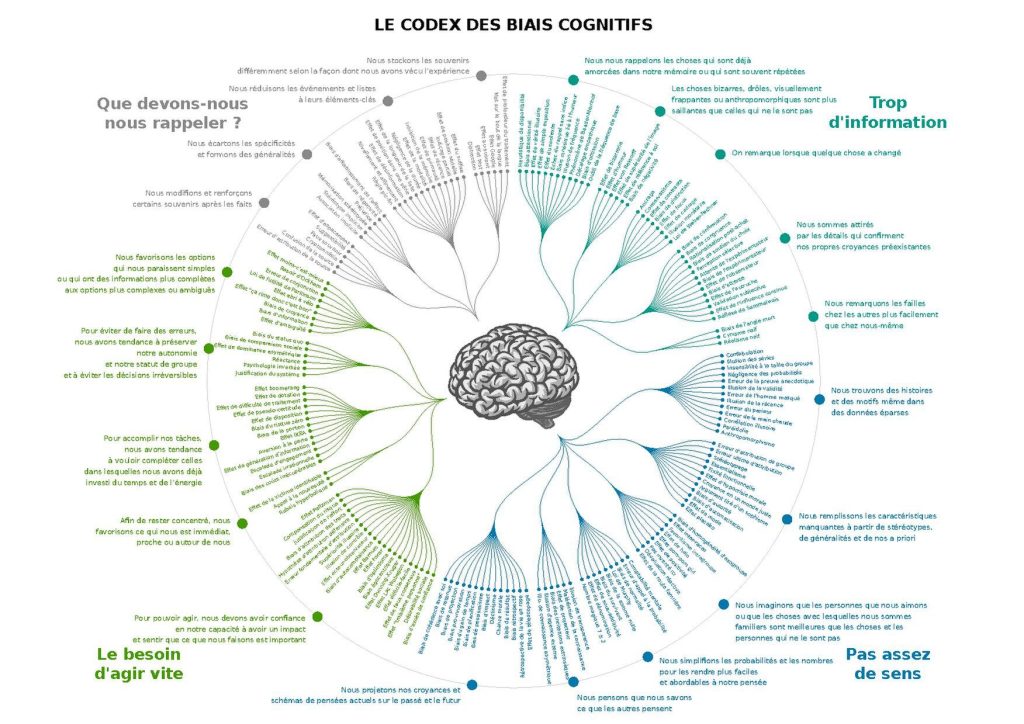
A pair of researchers developed the Cognitive Bias Codex in 2016 and updated it again in 2021. During the podcast, Dr. Mask suggests everyone take a peek—it can open your eyes wide to the why of your reactions and, as a marketer, I found it profoundly helpful for developing campaigns for my clients.
There are four basic categories that cause bias:
- Discerning What to Remember
- The Need to Act Fast
- When there is Not Enough Meaning
- When there is Too Much Information
Consider a typical day of your life. Technology has forced each of us into an “always on” society, meaning information is consistently coming at you (even when you aren’t willfully absorbing—think about those billboards you mindlessly see on your commute). As of 2023, the average American consumes 34 gigabytes of data each day. This is equivalent to reading War and Peace 1 to 3 times daily (for those not familiar, War and Peace is a classic literary novel written in 1865 and published in 1867 that is 1200 pages long with numerous characters and a complex narrative structure).
With all that information coming at you, your brain must find easy ways to sort and filter the information. If you look at the codex, it aligns parts of the brain with effects, laws, gaps, and biases to these four categories.
If you allow your mind to be on autopilot, well, you can see what happens (hello current state of the modern world!)
Taking back control of your mind and pausing in the moment to be present and aware of your defaults can open up a whole new realm of possibility. This is where you can seize creativity and unlock doors that most people ignore for a lifetime.
emotional attachment to outcomes
As Dr. Mask went on to explain in the discussion, it is very, very human to seek comfort, especially when a situation is already uncomfortable. He gives the example of meeting someone new and having dinner for the first time. Your first instinct is to take that person somewhere familiar to you so you can find comfort in an uncomfortable situation, especially if it is a meeting that can impact your future or you’re particularly worried about the first impression.
To me, this aligns with that pursuit of performance and attempts to control the uncontrollable.
Showing up authentically in any situation will best support the right outcome. Of course, as we just laid out, bias might cause your choice of restaurant to influence the outcome. Say, if your dinner guest is expecting a formal business dinner and you head to The Waffle House from the airport. That’s extreme, but as you can see there is a lot of sorting involved in the pursuit of something new or that you want to accomplish.
Regardless if the meeting takes place at The Waffle House or Del Frisco’s Steakhouse, ultimately, showing up as your authentic self is the most important thing. It is easy to think that if you make that good first impression on the interview or on a date or for a partnership that you will get the job, win their heart or earn the partnership. However, if that “first impression” was not true to the real you, well, you will be found out. It might not be today, in a week, month, or even a year, but someday living as that first impression self is going to hurt.
The key to showing up authentically is to realize that you can’t control the outcome and being honest and straightforward about who you are and what you want will yield the right result.
The emotional attachment to an outcome is often what holds you back. You attempt to wear the right outfit, choose the right restaurant, say the right thing all in hopes of “winning,” but all that does is potentially land you a role or a marriage or a partnership that was meant for whomever you pretended to be that day.
Authenticity is easier
While it might be uncomfortable, at first, to be “the real you,” in all situations, it is actually the easiest way to live. You get to let go the anxiety of “will he/she like me?” or “will I get the job?” If you are truly representing the authentic version of yourself, you will never have to fuss over that fear again.
Now, don’t confuse authenticity with narcissism or “I’m always right” kind of attitudes. Confidence in who you are and standing strong in your core values is not the same thing as always being right. You can be confident in your values and still be open to other thoughts and opinions. In fact, it is important to remember that values comprise who you are while beliefs may shift with new information—and that’s ok.
Next time a first impression is a deciding factor for a pivotal outcome in your life, let go and take comfort in the fact that you being you will yield the greatest results for your life.